





 Need help?
5 Steps to Buying the Best Dehumidifier for Your Home

The first sign of damp is often a dark bloom behind the loo or that musty smell that refuses to leave. So you decide to set on buy a dehumidifier, until your faced with litres per day, compressors vs desiccants, tank capacities, and running costs…A wall of jargon between you and a dry, fresh home.
Take a breath. This guide to buying the best dehumidifier cuts through the noise. By the end, you’ll know which dehumidifier you need, how big it should be, and how to use it so damp doesn’t get the upper hand.
1) Do You Need a Dehumidifier?
Unfortunately, most UK homes have damp to contend with – we just get used to it. Everyday things like cold weather, steamy showers, and wet washing hanging over radiators cause the air to grow heavy with moisture. Suddenly, your house feels colder than it should, even with the boiler working overtime.
Here are some tell-tale signs of excess moisture in your home:
- Condensation beading on windows
- Musty, slightly sour smells
- Black mould or speckled mildew
- Peeling wallpaper
- Swollen or rotting wood
- Triggered asthma/allergies
If you’re nodding along, don’t worry – a dehumidifier can help. But before you add one to your basket, be sure to rule out any leaks, because no machine can remedy a broken roof tile or cracked pipe. If water is getting in – not just lingering in the air – a dehumidifier won’t address the root cause.
To identify a leak:
- Run your hand the damp area
- Use a cheap damp meter
- Trace stains back to their source
If it is a leak, speak to a plumber or your water provider immediately – it’ll save you a lot of hassle down the line. If not, you’re dealing with humidity. But now you have a fighting chance.
Before you buy a dehumidifier, try:
- Opening windows after showers
- Use lids when boiling
- Dry laundry outdoors when possible
- Check hoses on washing machines/dryers
- Clean rugs (they hold moisture)
- Seal obvious cracks
If you try these fixes and the air still feels heavy, a dehumidifier is essential.
Black mould starts to flourish around ~50% humidity. But if you keep the humidity level below that, you’ll prevent it from forming. Read our expert blog for a detailed breakdown:
2) How Dehumidifiers Work (and Why Types Matter)
All dehumidifiers do the same job: they pull moisture from the air, collect it, and return it drier. But it’s how they do this that matters, because it determines:
- Where dehumidifiers work best
- How much water they can remove
- How much energy they use
Let’s look at the three main types of dehumidifiers, starting with the most common, the compressor.
Compressor Dehumidifiers (Refrigerant)
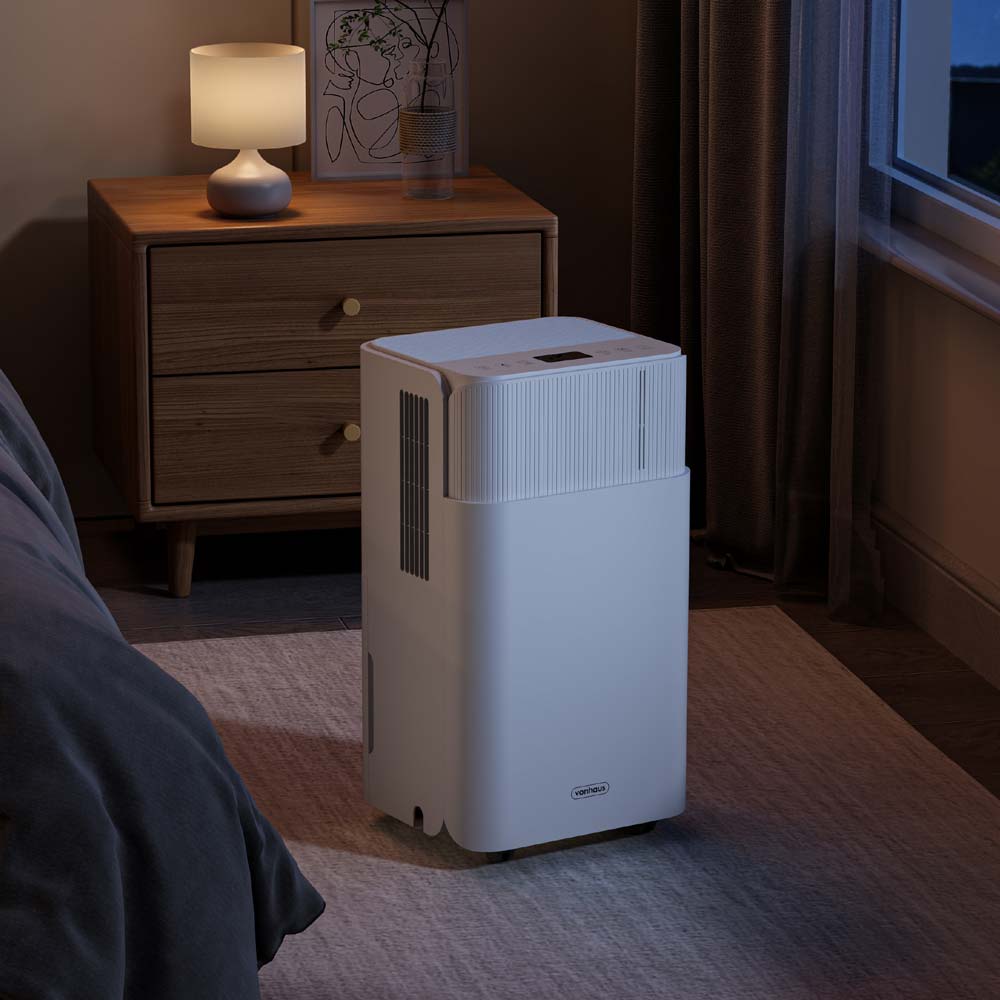
The dependable all-rounder.
Compressor dehumidifiers work like a fridge: moist air passes over cold coils, the water condenses and drips into the tank before it’s heated and dispersed as warm air.
Compressors are best suited in heated homes (≈15–30°C) where conditions are stable, making them a solid choice for most UK homes.
Why people choose them
- Strong extraction (≈10–25L/day)
- Great for laundry drying
- Efficient at normal room temperatures
Best for
- Everyday damp in bedrooms, living rooms & home offices
Desiccant Dehumidifiers

The cold-weather specialist.
Instead of cold coils, desiccant dehumidifiers use moisture-absorbing material on a rotating wheel. This makes them effective in spaces where compressors slow down. They’re often lighter and quieter than compressors, too.
Why people choose them
- Excellent in cold rooms
- Reliable when the heating isn’t on
- Good for remote spaces
Best for
- Garages, conservatories, lofts, utility rooms
Peltier Dehumidifiers (Thermo-Electric)
The lightweight problem-solver.
Peltier dehumidifiers work by passing air over a tiny heat sink, before condensing moisture into the tank. These are quiet and compact, but extraction is negligible.
Why people choose them
- Whisper-quiet
- Low running cost
- Very compact
Best for
- Cupboards, caravans, small bedrooms with light condensation
Which is the best dehumidifier for you?
|
Dehumidifier Type |
Best for |
Work Best At |
|
Compressor |
Most homes |
15–30°C |
|
Desiccant |
Cold rooms |
1–15°C |
|
Peltier |
Small spaces |
15°C+ |
3) What Size Dehumidifier Do You Need?
When it comes to dehumidifiers, size doesn’t refer to height or footprint – it’s the extraction capacity: how much water the unit can pull from the air in 24 hours. Typical UK dehumidifiers range from 250ml → ~20L/day.
Selecting the correct dehumidifier capacity is essential because you’ll solve your damp issue quickly while keeping electricity costs down.
How to Choose the Right Capacity Dehumidifier
Three things determine what you need:
- Room size
- How damp the space is
- Temperature
Rules of thumb
- Small room / light damp → 0.5–1.5L/day
- Most UK homes → 10–12L/day
- Heavy damp / drying laundry → 16–20L/day
If the space is cold (e.g., spare room, garage), desiccant dehumidifiers often outperform compressors with a higher capacity. To save hassle down the line, you can pick up a cheap hygrometer to identify your room’s humidity level.
When to size up
Go for 20L+ dehumidifier, like the Vonhaus 30L Dehumidifier with Laundry Mode, if:
- You’re drying laundry regularly
- Condensation returns daily
- Rooms smell musty
- You see wall/ceiling moisture
- Timber is warping
Quick Dehumidifier Size Guide
|
Damp Level |
Small Room |
Medium Room |
Large Room |
|
Mild |
0.25–1L |
1–10L |
10–12L |
|
Moderate |
0.25–0.5L |
8–12L |
12–16L |
|
Severe |
5L |
12–14L |
18–20L |
|
Drenched |
7L |
14–16L |
20–25L |
3) Dehumidifier Water Tank Size – Does It Matter?
The short answer is yes, but nowhere near as much as extraction capacity. A dehumidifier’s tank simply holds the moisture it pulls from the air. And most tanks are smaller than the unit’s daily extraction rating. For example, a 20L/day dehumidifier will not have a 20L tank, more like 3-4L. So, the why mismatch? Because once a room reaches healthy humidity, the dehumidifier cycles on and off, so the tank rarely fills to capacity each day.
What matters is:
- How often you’re home to empty it
- How damp the room is to begin with
As a rule of thumb, if you’re running your dehumidifier occasionally, a standard tank (12-20L) will suffice. So, you'll be safe with the following options:
- 12L Low Energy Dehumidifier with Laundry Mode
- 12L Auto Dehumidifier with Laundry Mode
- 20L Smart Dehumidifier with Laundry Mode
- 20L Portable Dehumidifer with Laundry Mode
But if the damp is severe or you’re leaving your dehumidifier on while you’re out, you'll be best off with our 30L Smart Dehumidifier with Laundry Mode.
5) Setting Up and Maintaining Your Dehumidifier
Dehumidifiers aren’t quite set-and-forget appliances, but they’re close. Here’s how to set yours up, use it properly, and maintain it so it keeps your home fresh and damp-free for years come.
First Time Dehumidifier Setup
On first use, your dehumidifier is clearing a backlog of moisture. Give it time – anywhere from 8–24 hours, depending on how damp the space is. Once the room settles to a healthy 40–50% humidity, most homes only need the unit 2–4 hours a day to maintain balance.
If you’re using a compressor dehumidifier, let it stand upright for an hour before switching on, so the refrigerant settles.
Where to Place Your Dehumidifier
Follow these simple placement tips to get the most out of your dehumidifier:
- Close windows & doors
- Position centrally for whole-room drying
- Leave 15cm+ clearance all around
Target problem areas by placing it nearer to wet walls, fogged windows or damp cupboards
- Plug directly into the mains (avoid extension leads)
Dehumidifier Modes & Settings
Auto mode
- Set your target humidity (≈45%) → the unit cycles only when needed
- Smart, simple & energy-efficient
Laundry mode
- High airflow to dry clothes quickly and cheaply
- Check out our Dehumidifiers with Laundry Mode
Continuous drainage
- The no-admin option for daily use
Target humidity:
- 40–50% most of the year
- 30–40% winter
Remember, above 50% is where mould thrives.
Dehumidifier Maintenance
Nothing complicated here, just a few spot checks to keep your dehumidifier running smoothly.
- Power off before cleaning
- Empty the tank regularly
- Wash the tank every 2–3 weeks to prevent mould
- Dust coils occasionally
- Coils icing up? The room is too cold → raise the unit or warm the space
- Clean the filter every 2–3 weeks
Peltiers
- Brush dust from vents
- Clean filters = stronger airflow, better extraction, and lower running costs.
The Vonhaus Free 2-Year Warranty
Your dehumidifier should last years – and we back that promise. Every Vonhaus dehumidifier includes:
And if something goes wrong within the warranty period, we’ll repair or replace your dehumidifier. You handle the humidity; we’ll handle the peace of mind.
Conclusion – Your Next Step
You’ve now got the essentials to choose the best dehumidifier for your home. Let’s recap:
- Confirm the damp in your home is humidity, not a leak
- Choose the best dehumidifier for your needs:
→ Compressor dehumididier for heated homes
→ Desiccant dehumidifier for cold spaces
→ Peltier for small, light jobs - Match the unit's tank capacity to room size & damp severity
- Use smart placement & auto mode
- Keep it clean
And that's it! Follow these simple tips, and you're sure to choose the best dehumidifier for your home. But if you're still not sure after browsing our dehumidifier range, narrow your list down to these three:
- Best dehumidifier for UK homes: Vonhaus 20L Dehumidifier with Laundry Mode
- Best dehumidifier for severe damp: Vonhaus 30L Smart Dehumidifier with Laundry Mode
- Best dehumidifier for cold rooms: Vonhaus 7L Desiccant Dehumidifier